 ce4f36a3ab
Edge cases found 2 real bugs: - cosine_similarity(NaN, ...) returned NaN instead of 0.0 - cosine_similarity(Infinity, ...) returned NaN instead of 0.0 Fix: added is_finite() guards on denom and raw ratio. New edge case tests by module: - vector.rs (18): NaN, Infinity, negative vectors, opposite vectors clamped, high-dimensional (1536), single element, both-zero, non-aligned bytes, 3-byte input, special float values, NaN roundtrip, limit=0, zero weights, negative BM25 scores, duplicate IDs, large normalization, single item - embeddings.rs (8): noop embed_one error, empty batch, multiple texts, empty/unknown provider, custom empty URL, no API key, trailing slash, dims - chunker.rs (11): headings-only, deeply nested ####, long single line, whitespace-only, max_tokens=0, max_tokens=1, unicode/emoji, FTS5 special chars, multiple blank lines, trailing heading, no content loss - sqlite.rs (23): FTS5 quotes/asterisks/parens, SQL injection, empty content/key, 100KB content, unicode+emoji, newlines+tabs, single char query, limit=0/1, key matching, unicode query, schema idempotency, triple open, ghost results after forget, forget+re-store cycle, reindex empty/twice, content_hash empty/unicode/long, category roundtrip with spaces/empty, list custom category, list empty DB 869 tests passing, 0 clippy warnings, cargo-deny clean |
||
|---|---|---|
| .github/workflows | ||
| docs | ||
| examples | ||
| src | ||
| tests | ||
| .gitignore | ||
| architecture.jpeg | ||
| Cargo.lock | ||
| Cargo.toml | ||
| CHANGELOG.md | ||
| CONTRIBUTING.md | ||
| deny.toml | ||
| Dockerfile | ||
| LICENSE | ||
| README.md | ||
| SECURITY.md | ||
| zeroclaw.png | ||



ZeroClaw 🦀
Zero overhead. Zero compromise. 100% Rust. 100% Agnostic.

The fastest, smallest, fully autonomous AI assistant — deploy anywhere, swap anything.
~3MB binary · <10ms startup · 657 tests · 22+ providers · Pluggable everything
Quick Start
git clone https://github.com/theonlyhennygod/zeroclaw.git
cd zeroclaw
cargo build --release

# Initialize config + workspace
cargo run --release -- onboard

# Set your API key
export OPENROUTER_API_KEY="sk-..."

# Chat
cargo run --release -- agent -m "Hello, ZeroClaw!"

# Interactive mode
cargo run --release -- agent

# Check status
cargo run --release -- status --verbose

# List tools (includes memory tools)
cargo run --release -- tools list

# Test a tool directly
cargo run --release -- tools test memory_store '{"key": "lang", "content": "User prefers Rust"}'
cargo run --release -- tools test memory_recall '{"query": "Rust"}'
Tip: Run
cargo install --path .to installzeroclawglobally, then usezeroclawinstead ofcargo run --release --.
Architecture
Every subsystem is a trait — swap implementations with a config change, zero code changes.
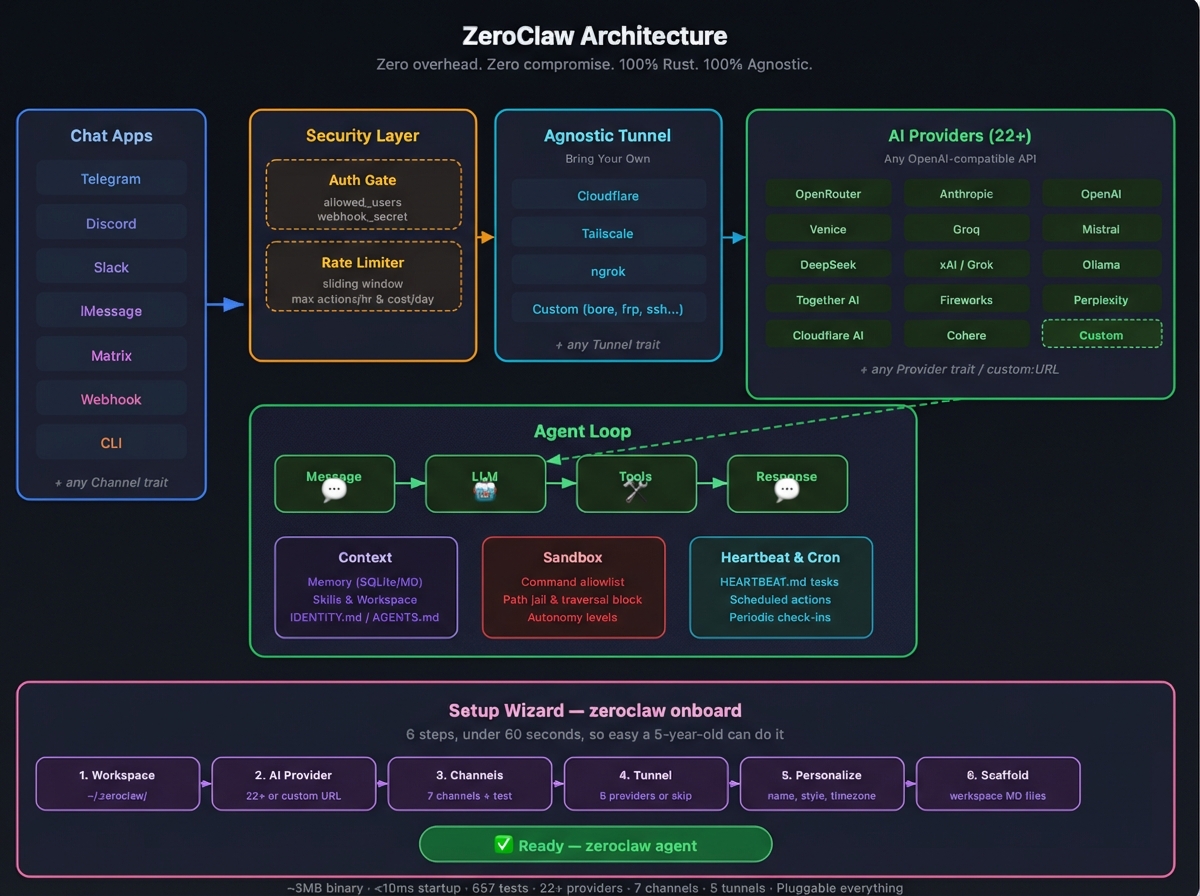
| Subsystem | Trait | Ships with | Extend |
|---|---|---|---|
| AI Models | Provider |
22+ providers (OpenRouter, Anthropic, OpenAI, Venice, Groq, Mistral, etc.) | custom:https://your-api.com — any OpenAI-compatible API |
| Channels | Channel |
CLI, Telegram, Discord, Slack, iMessage, Matrix, Webhook | Any messaging API |
| Memory | Memory |
SQLite (default), Markdown | Any persistence |
| Tools | Tool |
shell, file_read, file_write, memory_store, memory_recall, memory_forget | Any capability |
| Observability | Observer |
Noop, Log, Multi | Prometheus, OTel |
| Runtime | RuntimeAdapter |
Native (Mac/Linux/Pi) | Docker, WASM |
| Security | SecurityPolicy |
Sandbox + allowlists + rate limits | — |
| Tunnel | Tunnel |
None, Cloudflare, Tailscale, ngrok, Custom | Any tunnel binary |
| Heartbeat | Engine | HEARTBEAT.md periodic tasks | — |
Memory System
ZeroClaw has a built-in brain. The agent automatically:
- Recalls relevant memories before each prompt (context injection)
- Saves conversation turns to memory (auto-save)
- Manages its own memory via tools (store/recall/forget)
Two backends — SQLite (default, searchable, upsert, delete) and Markdown (human-readable, append-only, git-friendly). Switch with one config line.
Security Architecture
ZeroClaw enforces security at every layer — not just the sandbox. Every message passes through authentication and rate limiting before reaching the agent.
Layer 1: Channel Authentication
Every channel validates the sender before the message reaches the agent loop:
| Channel | Auth Method | Config |
|---|---|---|
| Telegram | allowed_users list (username match) |
[channels.telegram] allowed_users |
| Discord | allowed_users list (user ID match) |
[channels.discord] allowed_users |
| Slack | allowed_users list (user ID match) |
[channels.slack] allowed_users |
| Matrix | allowed_users list (MXID match) |
[channels.matrix] allowed_users |
| iMessage | allowed_contacts list |
[channels.imessage] allowed_contacts |
| Webhook | X-Webhook-Secret header (shared secret) |
[channels.webhook] secret |
| CLI | Local-only (inherently trusted) | — |
Note: An empty
allowed_userslist or["*"]allows all users (open mode). Set specific IDs for production.
Layer 2: Rate Limiting
- Sliding-window tracker — counts actions within a 1-hour rolling window
max_actions_per_hour— hard cap on tool executions (default: 20)max_cost_per_day_cents— daily cost ceiling (default: $5.00)
Layer 2.5: Agnostic Tunnel
Expose your gateway securely to the internet — bring your own tunnel provider. ZeroClaw doesn't lock you into Cloudflare or any single vendor.
| Provider | Binary | Use Case |
|---|---|---|
| none | — | Local-only (default) |
| cloudflare | cloudflared |
Cloudflare Zero Trust tunnel |
| tailscale | tailscale |
Tailnet-only (serve) or public (funnel) |
| ngrok | ngrok |
Quick public URLs, custom domains |
| custom | Any | Bring your own: bore, frp, ssh, WireGuard, etc. |
[tunnel]
provider = "tailscale"   # "none", "cloudflare", "tailscale", "ngrok", "custom"

[tunnel.tailscale]
funnel = true            # true = public internet, false = tailnet only

# Or use Cloudflare:
# [tunnel]
# provider = "cloudflare"
# [tunnel.cloudflare]
# token = "your-tunnel-token"

# Or ngrok:
# [tunnel]
# provider = "ngrok"
# [tunnel.ngrok]
# auth_token = "your-ngrok-token"
# domain = "my-zeroclaw.ngrok.io"  # optional

# Or bring your own:
# [tunnel]
# provider = "custom"
# [tunnel.custom]
# start_command = "bore local {port} --to bore.pub"
# url_pattern = "https://"         # regex to extract URL from stdout
# health_url = "http://localhost:4040/api/tunnels"  # optional
The tunnel starts automatically with zeroclaw gateway and prints the public URL.
Layer 3: Tool Sandbox
- Workspace sandboxing — can't escape workspace directory
- Command allowlisting — only approved shell commands (
git,cargo,ls, etc.) - Path traversal blocking —
..and absolute paths blocked - Forbidden paths —
/etc,/root,~/.ssh,~/.gnupgalways blocked - Autonomy levels —
ReadOnly(observe only),Supervised(acts with policy),Full(autonomous within bounds)
Configuration
Config: ~/.zeroclaw/config.toml (created by onboard)
Documentation Index
Fetch the complete documentation index at: https://docs.openclaw.ai/llms.txt Use this file to discover all available pages before exploring further.
Token Use & Costs
ZeroClaw tracks tokens, not characters. Tokens are model-specific, but most OpenAI-style models average ~4 characters per token for English text.
How the system prompt is built
ZeroClaw assembles its own system prompt on every run. It includes:
- Tool list + short descriptions
- Skills list (only metadata; instructions are loaded on demand with
read) - Self-update instructions
- Workspace + bootstrap files (
AGENTS.md,SOUL.md,TOOLS.md,IDENTITY.md,USER.md,HEARTBEAT.md,BOOTSTRAP.mdwhen new, plusMEMORY.mdand/ormemory.mdwhen present). Large files are truncated byagents.defaults.bootstrapMaxChars(default: 20000).memory/*.mdfiles are on-demand via memory tools and are not auto-injected. - Time (UTC + user timezone)
- Reply tags + heartbeat behavior
- Runtime metadata (host/OS/model/thinking)
What counts in the context window
Everything the model receives counts toward the context limit:
- System prompt (all sections listed above)
- Conversation history (user + assistant messages)
- Tool calls and tool results
- Attachments/transcripts (images, audio, files)
- Compaction summaries and pruning artifacts
- Provider wrappers or safety headers (not visible, but still counted)
How to see current token usage
Use these in chat:
/status→ emoji-rich status card with the session model, context usage, last response input/output tokens, and estimated cost (API key only)./usage off|tokens|full→ appends a per-response usage footer to every reply.- Persists per session (stored as
responseUsage). - OAuth auth hides cost (tokens only).
- Persists per session (stored as
/usage cost→ shows a local cost summary from ZeroClaw session logs.
Other surfaces:
- TUI/Web TUI:
/status+/usageare supported. - CLI:
zeroclaw status --usageandzeroclaw channels listshow provider quota windows (not per-response costs).
Cost estimation (when shown)
Costs are estimated from your model pricing config:
models.providers.<provider>.models[].cost
These are USD per 1M tokens for input, output, cacheRead, and
cacheWrite. If pricing is missing, ZeroClaw shows tokens only. OAuth tokens
never show dollar cost.
Cache TTL and pruning impact
Provider prompt caching only applies within the cache TTL window. ZeroClaw can optionally run cache-ttl pruning: it prunes the session once the cache TTL has expired, then resets the cache window so subsequent requests can re-use the freshly cached context instead of re-caching the full history. This keeps cache write costs lower when a session goes idle past the TTL.
Configure it in Gateway configuration and see the behavior details in Session pruning.
Heartbeat can keep the cache warm across idle gaps. If your model cache TTL
is 1h, setting the heartbeat interval just under that (e.g., 55m) can avoid
re-caching the full prompt, reducing cache write costs.
For Anthropic API pricing, cache reads are significantly cheaper than input tokens, while cache writes are billed at a higher multiplier. See Anthropic's prompt caching pricing for the latest rates and TTL multipliers: https://docs.anthropic.com/docs/build-with-claude/prompt-caching
Example: keep 1h cache warm with heartbeat
agents:
  defaults:
    model:
      primary: "anthropic/claude-opus-4-6"
    models:
      "anthropic/claude-opus-4-6":
        params:
          cacheRetention: "long"
    heartbeat:
      every: "55m"
Tips for reducing token pressure
- Use
/compactto summarize long sessions. - Trim large tool outputs in your workflows.
- Keep skill descriptions short (skill list is injected into the prompt).
- Prefer smaller models for verbose, exploratory work.
api_key = "sk-..."
default_provider = "openrouter"
default_model = "anthropic/claude-sonnet-4-20250514"
default_temperature = 0.7

[memory]
backend = "sqlite"  # "sqlite", "markdown", "none"
auto_save = true

[autonomy]
level = "supervised"  # "readonly", "supervised", "full"
workspace_only = true
allowed_commands = ["git", "npm", "cargo", "ls", "cat", "grep"]

[heartbeat]
enabled = false
interval_minutes = 30
Commands
| Command | Description |
|---|---|
onboard |
Initialize workspace and config |
agent -m "..." |
Single message mode |
agent |
Interactive chat mode |
status -v |
Show full system status |
tools list |
List all 6 tools |
tools test <name> <json> |
Test a tool directly |
gateway |
Start webhook/WebSocket server |
Development
cargo build              # Dev build
cargo build --release    # Release build (~3MB)
cargo test               # 657 tests
cargo clippy             # Lint (0 warnings)

# Run the SQLite vs Markdown benchmark
cargo test --test memory_comparison -- --nocapture
Project Structure
src/
├── main.rs           # CLI (clap)
├── lib.rs            # Library exports
├── agent/            # Agent loop + context injection
├── channels/         # Channel trait + CLI
├── config/           # TOML config schema
├── cron/             # Scheduled tasks
├── heartbeat/        # HEARTBEAT.md engine
├── memory/           # Memory trait + SQLite + Markdown
├── observability/    # Observer trait + Noop/Log/Multi
├── providers/        # Provider trait + 22 providers
├── runtime/          # RuntimeAdapter trait + Native
├── security/         # Sandbox + allowlists + autonomy
├── tools/            # Tool trait + shell/file/memory tools
└── tunnel/           # Tunnel trait + Cloudflare/Tailscale/ngrok/Custom
examples/
├── custom_provider.rs
├── custom_channel.rs
├── custom_tool.rs
└── custom_memory.rs
tests/
└── memory_comparison.rs  # SQLite vs Markdown benchmark
License
MIT — see LICENSE
Contributing
See CONTRIBUTING.md. Implement a trait, submit a PR:
- New
Provider→src/providers/ - New
Channel→src/channels/ - New
Observer→src/observability/ - New
Tool→src/tools/ - New
Memory→src/memory/
ZeroClaw — Zero overhead. Zero compromise. Deploy anywhere. Swap anything. 🦀